China International College Students’ “Internet+” Innovation and Entrepreneurship Competition · Competition Team Lead · 2023.01-2023.07 · Published: 2023-07-22
HandsFree: Urban Unmanned Loading and Unloading Solution
An Integrated Intelligent Cargo-Handling System for Unmanned Delivery Vehicles
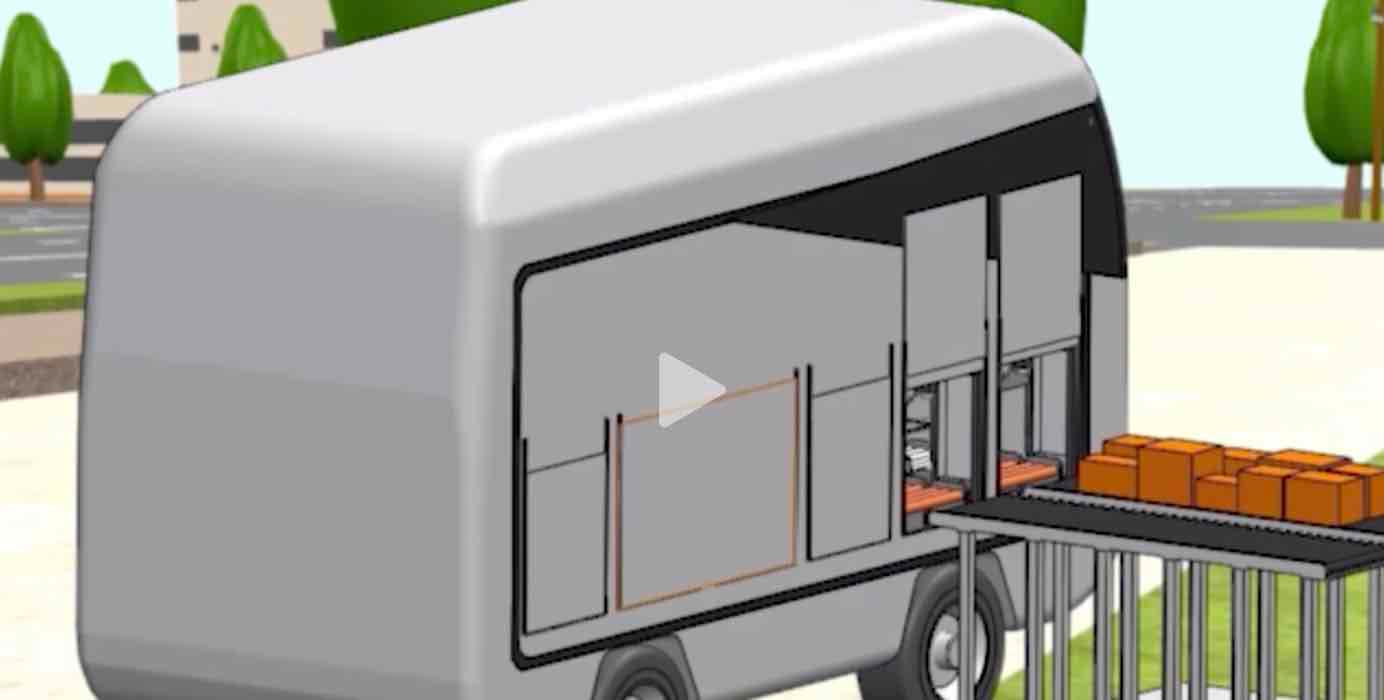
01 · Video
Product introduction
02 · Project Background and Industry Challenges
Unmanned delivery vehicles are increasingly being deployed in communities, commercial districts, warehouses, retail stores, industrial parks, and factories. Through autonomous driving, environmental perception, path planning, and remote management, these vehicles can complete much of the transportation process without an onboard driver.
However, existing unmanned delivery vehicles still face a critical limitation: although the transportation process can be automated, cargo loading and unloading often depend on manual labor. Workers are still required to place goods inside the vehicle, organize the cargo, retrieve packages, and transfer them to the final delivery location. As a result, many so-called unmanned delivery services have automated only the driving stage rather than the entire logistics process.
Manual cargo handling also introduces additional operating costs, inconsistent efficiency, safety risks, and difficulties in coordinating people and vehicles. These problems become more significant in high-frequency delivery scenarios, where vehicles must complete repeated loading and unloading tasks throughout the day.
The Unloading Pro Team identified the inability of unmanned delivery vehicles to autonomously load and unload cargo as a key obstacle to the large-scale development of unmanned logistics. The team therefore focused on intelligent loading and unloading technologies and proposed HandsFree, an integrated solution designed to extend automation from vehicle transportation to cargo handling.
The project aims to enable unmanned delivery vehicles to complete loading, transportation, and unloading as a continuous automated process, helping the industry move from “unmanned driving” toward true end-to-end “unmanned delivery.”
- Autonomous vehicles can complete transportation but still rely on people for cargo handling.
- Manual loading and unloading increase costs and reduce the value of unmanned delivery.
- HandsFree extends automation from vehicle movement to the complete logistics workflow.
03 · Team Vision and Product Positioning
The Unloading Pro Team focuses on the research and development of intelligent loading and unloading solutions for unmanned delivery vehicles. Its goal is to provide a portfolio of products that includes intelligent cargo-handling devices, automated control systems, and information management platforms.
Different logistics scenarios have different requirements for vehicle size, cargo dimensions, package weight, loading frequency, unloading method, delivery process, and operating environment. Therefore, the team does not limit the project to a single standardized device. Instead, it adopts a multi-scenario and demand-oriented product strategy.
The solution can be customized according to the needs of vehicle manufacturers, logistics enterprises, commercial operators, and individual users. Relevant modules can be selected and configured on demand, allowing the product to adapt to different vehicle platforms and cargo-handling workflows.
The team positions HandsFree as an enabling system for the unmanned delivery industry. Its purpose is not to replace the autonomous vehicle itself, but to provide the missing loading and unloading capability that allows the vehicle to operate without human intervention throughout the delivery process.
Through intelligent, efficient, and safe unmanned cargo-handling services, the team aims to help unmanned delivery vehicles move beyond autonomous transportation and achieve true operational autonomy.
- A product portfolio combining hardware, control, and information management.
- Customizable configurations for multiple vehicles and application scenarios.
- On-demand deployment based on the needs of customers and logistics workflows.
- A key enabling system for true unmanned delivery.
04 · HandsFree Core Product
The team developed HandsFree as its core product based on unmanned loading and unloading technology. The product consists of an intelligent loading and unloading device and its associated control system and can be integrated into the cargo compartment of an unmanned delivery vehicle.
HandsFree is designed to assist with cargo loading, internal transfer, positioning, storage, retrieval, and unloading. Through coordinated mechanical movement and control logic, the system manages the movement of goods between the vehicle and the designated delivery interface.
The intelligent loading and unloading device serves as the physical execution layer. It performs cargo-handling actions through a mechanical structure designed for installation inside the limited space of an unmanned vehicle.
The control system serves as the decision-making and coordination layer. It receives task instructions, controls the sequence of mechanical actions, monitors operating status, and coordinates the loading and unloading process with the unmanned vehicle.
The information management system provides a digital layer for tasks, cargo, equipment, and operating data. It can support order association, task assignment, cargo status records, device monitoring, exception reporting, and operational traceability.
Together, these components form an integrated intelligent loading and unloading solution rather than an isolated mechanical device. The system can be customized according to the vehicle platform, cargo characteristics, operating environment, and customer workflow.
- Intelligent loading and unloading device installed inside the vehicle.
- Control system for mechanical actions and process coordination.
- Information management system for tasks, cargo, equipment, and operating data.
- Customizable architecture for different customer requirements.
05 · Technical Architecture and Operating Workflow
HandsFree integrates mechanical design, embedded control, sensor-based state detection, motion execution, task management, and system communication.
Before a loading or unloading task begins, the system receives task information from the vehicle platform or information management system. The task can include cargo information, loading position, unloading destination, operation sequence, and vehicle status.
During cargo loading, the device receives the goods through a designated interface and transfers them into the vehicle. The control system coordinates the mechanical structure to place or organize the cargo according to the available storage space and task requirements.
During transportation, the system records the status and position of the cargo. The integrated structure is designed to make effective use of the limited interior space while reducing unnecessary movement and interference among different items.
After the vehicle reaches the destination, the control system identifies the relevant cargo according to the delivery task. The loading and unloading device then retrieves and transfers the goods to the designated handover point.
Throughout the process, the system can monitor mechanical position, action status, task progress, and equipment conditions. When abnormal conditions occur, the control and information systems can suspend the operation, record the issue, or request manual intervention.
This coordinated workflow connects cargo handling with the operating logic of the autonomous delivery vehicle, allowing loading, transportation, and unloading to function as a unified process.
06 · Product Advantages
Compared with conventional loading and unloading devices, HandsFree offers clear advantages in economy, space utilization, and operational efficiency.
In terms of economy, the system reduces dependence on dedicated loading and unloading personnel. By extending automation to the cargo-handling stage, operators can reduce repeated manual work and improve the utilization of unmanned vehicles.
In terms of space utilization, the product is designed for integration into the constrained interior space of unmanned delivery vehicles. The mechanical structure and cargo organization method are jointly considered so that the device can perform loading and unloading tasks without occupying excessive cargo capacity.
In terms of efficiency, automated actions can be executed through predefined control procedures. This reduces delays caused by manual coordination and makes the duration and sequence of cargo-handling tasks more predictable.
The product also has strong technical universality. Its structure, control logic, and system interfaces can be adjusted for different vehicle platforms and logistics requirements. This enables the solution to serve multiple applications rather than being restricted to a single vehicle model or delivery scenario.
The project achieved an approximately 35% improvement in loading and unloading efficiency and an approximately 20% reduction in operational error during development and validation.
- Lower labor dependence and improved operational economy.
- Efficient use of limited vehicle interior space.
- Faster and more predictable cargo-handling operations.
- Adaptability across vehicle platforms and logistics scenarios.
- Approximately 35% higher efficiency and 20% lower operational error.
07 · Research Support and Prototype Development
HandsFree was developed with the support of the National and Local Joint Engineering Laboratory of Comprehensive Intelligent Transportation at Southwest Jiaotong University.
The research environment provided technical support for intelligent transportation, unmanned systems, mechanical structures, control technologies, and system integration. Based on this support, the team advanced the project from an industry problem and product concept to a functional prototype.
The development process covered product definition, application analysis, structural design, control-system development, device integration, and preliminary debugging. The team also considered the installation requirements of unmanned vehicles, the limited internal space, cargo-handling efficiency, and the universality of the system.
At the current stage described in the project, the product had completed preliminary debugging. The initial results demonstrated technical innovation, functional feasibility, and strong potential for adaptation across multiple vehicle platforms and application scenarios.
The prototype provides a foundation for further reliability testing, scenario validation, design optimization, production engineering, and commercial deployment.
08 · Target Customers and Application Scenarios
The primary customers of HandsFree are unmanned vehicle manufacturers. The product can be assembled inside an unmanned delivery vehicle and delivered as part of the vehicle’s cargo-handling capability.
Other potential customers include logistics enterprises, community delivery operators, retail distribution platforms, warehouse operators, factories, industrial parks, and enterprises or individuals with delivery and cargo-transfer needs.
The target market is divided into three main application scenarios: community delivery, warehouse-to-store distribution, and factory distribution.
In community delivery, unmanned vehicles can transport groceries, parcels, daily necessities, and other items between distribution stations and residential areas. HandsFree can reduce the need for people to repeatedly load and unload the vehicle.
In warehouse-to-store distribution, the system can assist with the movement of goods from warehouses or front warehouses to retail stores. Automated cargo handling can improve the turnaround efficiency of vehicles involved in frequent replenishment operations.
In factory distribution, the solution can support the transportation of materials, components, tools, and finished products among warehouses, workshops, production lines, and designated delivery points.
The project estimates that the overall target market across these application areas could reach RMB 8.34382 trillion.
09 · Business Model and Commercialization Strategy
HandsFree targets the unmanned loading and unloading market and addresses the unresolved cargo-handling limitations of current unmanned delivery vehicles.
During the initial commercialization stage, the team adopted a cooperative production and sales model. It signed an entrusted production and sales agreement with Chongqing Tesco Technology Co., Ltd., authorizing the partner to participate in product manufacturing and sales.
Under this model, the team can share a portion of the profits generated from product sales. This approach allows the project to use an external partner’s production and commercial resources while reducing the initial burden of establishing a complete manufacturing and sales system independently.
Through early product delivery and partner-based sales, the team plans to validate customer demand, accumulate application cases, acquire customer resources, and gradually establish brand influence.
As the product and business mature, the team intends to develop an independent production system and proprietary sales channels. This transition can provide greater control over product quality, delivery capability, customer relationships, and commercial returns.
The project will also integrate resources related to unmanned delivery, including vehicle manufacturers, logistics operators, equipment suppliers, application customers, and supporting technology providers. Based on its intelligent loading and unloading products and technologies, the team aims to build an integrated smart logistics ecosystem.
Potential revenue sources include intelligent loading and unloading device sales, control-system delivery, information management software, customization fees, technology licensing, installation and integration services, equipment maintenance, and revenue-sharing partnerships.
10 · Financial Plan and Growth Targets
According to the original project plan, HandsFree expects to raise RMB 1.9274 billion to support product development and commercialization.
The financing will provide resources for technology research and development, product optimization, prototype iteration, production engineering, manufacturing capacity, market expansion, sales-channel development, talent recruitment, customer acquisition, and ecosystem construction.
Within five years of commercial operation, the project expects to achieve cumulative operating revenue of RMB 77.06 billion, excluding tax.
The team expects the project to establish strong operational capabilities within three years of launch. During this period, the focus will be on improving the product, validating key application scenarios, expanding production and sales capabilities, acquiring customers, and building repeatable delivery processes.
Within five years of launch, the project aims to develop into a recognized brand with significant influence in the intelligent loading and unloading sector. This goal includes establishing a mature product portfolio, independent production capabilities, stable sales channels, customer resources, and an integrated network of unmanned logistics partners.
These figures represent the original project’s financing and revenue projections. Actual performance would depend on product maturity, manufacturing costs, commercialization progress, customer adoption, market development, and the growth rate of the unmanned delivery industry.
11 · Project Outcomes and Progress
The project completed the initial development and preliminary debugging of the HandsFree intelligent loading and unloading device and its control system.
The prototype demonstrated the technical feasibility of integrating an intelligent cargo-handling mechanism into an unmanned delivery vehicle. It also showed the potential to adapt the solution to different vehicles, customer requirements, and application scenarios.
With the support of the National and Local Joint Engineering Laboratory of Comprehensive Intelligent Transportation at Southwest Jiaotong University, the team established a foundation covering product design, technical development, prototype integration, and functional verification.
The project signed an entrusted production and sales agreement with Chongqing Tesco Technology Co., Ltd., marking its initial transition from prototype development to commercial cooperation.
HandsFree also received a National Bronze Award in the China International College Students’ “Internet+” Innovation and Entrepreneurship Competition, demonstrating recognition of its innovation, application value, and business potential.
12 · Long-Term Vision
The long-term objective of HandsFree is to become a core intelligent cargo-handling platform for the unmanned delivery industry.
As unmanned vehicles become more capable, autonomous driving alone will no longer be sufficient to define an unmanned logistics system. Vehicles must also be able to receive, organize, transport, retrieve, and deliver cargo without continuous human assistance.
HandsFree aims to provide this missing connection between autonomous transportation and automated cargo handling. Through standardized product modules and customized solutions, the platform can gradually support a wider range of vehicles, cargo types, and logistics workflows.
The team plans to integrate intelligent loading and unloading equipment, control systems, information platforms, unmanned vehicles, logistics operators, and application scenarios into a coordinated ecosystem.
By establishing independent production capabilities, sales channels, customer resources, and industry partnerships, HandsFree aims to become a recognized brand with substantial influence in the intelligent loading and unloading market.
Ultimately, the project seeks to promote the transition of urban logistics from isolated vehicle automation to intelligent, efficient, and safe end-to-end unmanned operation.