Southwest Jiaotong University · Undergraduate Research Project · Team Member · 2021.04-2022.05 · Published: 2021-05-01
Data Collection and Processing Based on Python and Wi-Fi
A reliable real-time data transmission and speech signal processing system
01 · Project Information
Project Duration: April 2021 - May 2022
Role: Team Leader
Advisor: Prof. Yongzhi Jing, Southwest Jiaotong University
02 · Project Overview
This project focused on data collection and processing using Python and Wi-Fi communication, aiming to achieve highly reliable real-time data transmission and advanced speech signal processing.
The project covered three primary areas:
Developing a Python-based TCP interactive system for real-time data collection
Improving transmission reliability between senders and receivers
Applying deep learning-based signal processing to improve speech clarity
The project was completed 20% ahead of schedule while maintaining 100% adherence to progress milestones.
03 · Project Objectives
The primary objectives were to:
Develop a highly reliable Wi-Fi-based real-time data collection system
Establish robust TCP communication to prevent data loss
Improve speech signal clarity using deep clustering
Optimize the system for future IoT and real-time monitoring applications
04 · Technical Implementation
1. Python-Based TCP Interactive Data Collection System
A custom Python-based TCP communication framework was developed for real-time data collection and transmission.
The implementation included:
Establishing TCP connections between senders and receivers
Designing a real-time data transmission and interaction mechanism
Implementing error detection and correction
Optimizing TCP communication parameters
Verifying the integrity of received data
Recording system transmission status
The system achieved 99.5% data transmission reliability between senders and receivers.
2. Deep Clustering for Speech Signal Processing
Deep clustering was applied to separate overlapping speech signals and improve speech clarity.
The signal-processing workflow included:
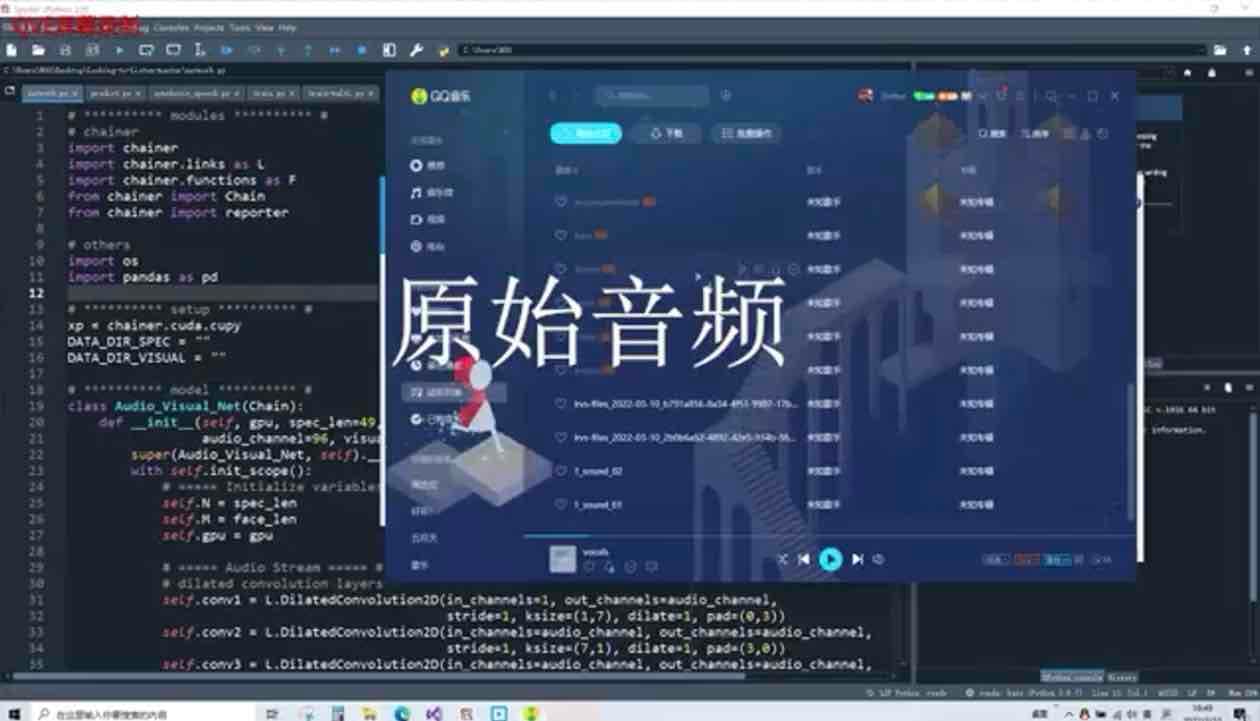
Preprocessing the original speech signals
Converting speech signals into the frequency domain
Extracting relevant speech frequency components
Applying deep clustering to distinguish overlapping voices
Reconstructing the separated speech signals
Comparing speech clarity before and after processing
The combination of deep clustering and frequency-domain analysis improved overlapping speech-signal separation by 30%.
3. System Performance Optimization
The system was optimized for transmission latency, real-time processing efficiency, and scalability.
The optimization work included:
Conducting tests in real-world environments
Optimizing the data transmission and reception process
Improving buffer-management strategies
Applying Python multithreading to improve processing efficiency
Reducing waiting time during data transmission and processing
Designing a modular software architecture
The modular architecture made the system adaptable to larger datasets and future IoT monitoring applications.
05 · System Workflow
The system followed the process below:
Collect raw data at the sender
Format the collected data
Establish a TCP connection through Wi-Fi
Transmit the data to the receiver in real time
Verify the integrity of the transmitted data
Perform frequency-domain analysis on speech data
Apply deep clustering to separate overlapping speech signals
Output and store the processed data
Record system status and test results
06 · Challenges and Solutions
07 · My Responsibilities
As the team leader, I was responsible for:
Defining the research objectives and implementation plan
Dividing the project into milestones and tracking progress
Coordinating tasks among team members
Participating in the design of the Python TCP communication system
Managing data-transmission reliability testing
Supporting the speech-signal processing research
Organizing system integration and performance evaluation
Preparing project documentation and results
Managing project progress and milestone delivery
Through structured task allocation and progress management, the team completed the project 20% ahead of schedule while meeting 100% of its planned milestones.
08 · Key Contributions and Outcomes
Developed a real-time data collection system using Python and Wi-Fi
Established an interactive TCP communication mechanism
Achieved 99.5% data transmission reliability
Applied deep clustering to overlapping speech signals
Improved speech-signal separation by 30%
Improved real-time processing through multithreading and buffer optimization
Designed a modular architecture for future system expansion
Completed the project 20% ahead of schedule
Maintained 100% adherence to project milestones
09 · Project Impact
The project demonstrated the feasibility of using Python and TCP communication for real-time wireless data collection. It also integrated data transmission and speech-signal processing within a unified system.
The modular architecture could be extended to:
IoT data acquisition
Environmental monitoring
Real-time equipment monitoring
Wireless sensor data transmission
Intelligent speech processing
Mobile data collection
10 · Conclusion
This project successfully implemented a Python-based TCP interactive data collection system with highly reliable Wi-Fi transmission and advanced speech-signal processing capabilities.
Through the project, I strengthened my knowledge of wireless communication, TCP data transmission, Python multithreading, buffer management, and speech-signal processing. I also gained practical experience in team leadership, project planning, system testing, and performance optimization.
11 · Future Work
Future development could focus on:
Integrating AI-driven adaptive learning to improve real-time speech-processing accuracy
Expanding the system into broader IoT applications such as environmental monitoring
Optimizing wireless communication protocols to reduce latency in large-scale deployments
Developing a mobile-friendly version for portable real-time data collection