Southwest Jiaotong University · National Research Project · Team Leader · 2022.04-2024.05 · Published: 2024-05-15
In-Vehicle Driver Health Monitoring and Alarming System
A non-intrusive driver fatigue and in-vehicle environment monitoring system
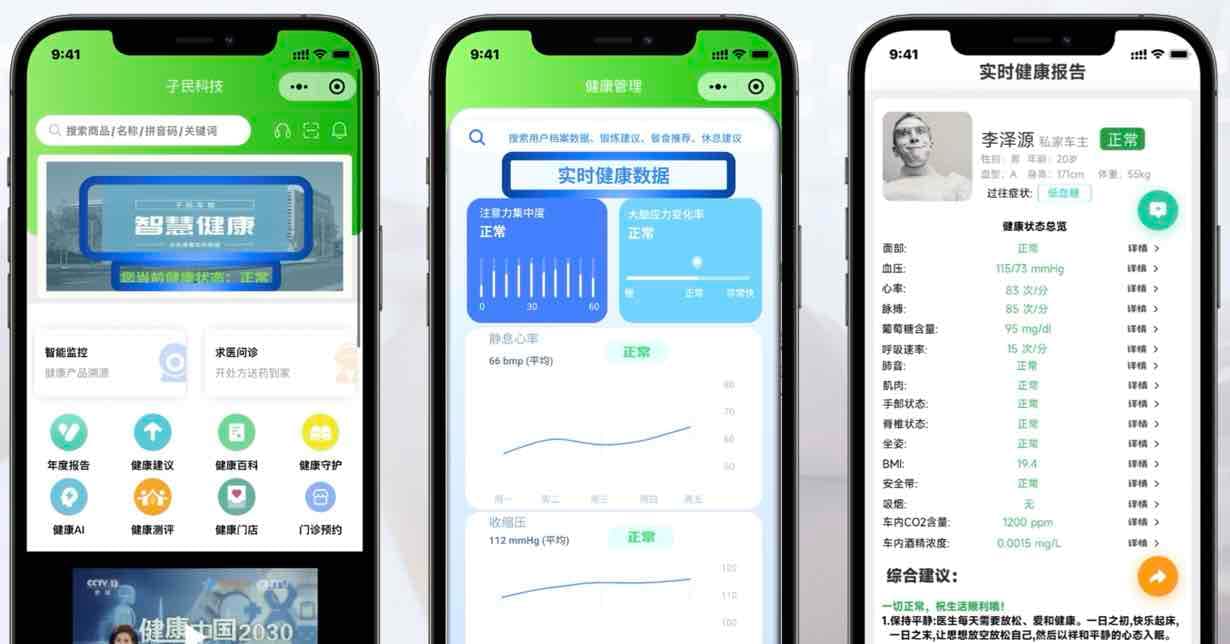
01 · Project Information
Project Duration: April 2022 - May 2024
Role: Team Leader
Advisor: Prof. Yi Zhang, Southwest Jiaotong University
Project Type: National Research Project
02 · Project Overview
This project aimed to develop an advanced in-vehicle driver health monitoring and alarming system capable of identifying early signs of driver fatigue and hazardous environmental conditions.
The system combined real-time environmental monitoring with physiological data acquisition to evaluate driver well-being and maintain suitable in-vehicle conditions. When physiological or environmental parameters deviated from their expected ranges, the system identified the potential risk and activated an appropriate intervention.
The key innovations included:
Real-time monitoring of in-vehicle temperature and carbon dioxide levels
Non-intrusive ECG acquisition using fabric electrodes
Fatigue analysis based on heart rate and heart rate variability
Multi-sensor fusion to reduce false alarms
Multi-modal alerts for driver intervention
Wireless communication and edge processing for real-time operation
03 · Project Background
Driver fatigue is affected not only by sleep and driving duration but also by environmental conditions and physiological changes.
Excessive carbon dioxide levels and unsuitable temperatures can contribute to drowsiness, reduced attention, and slower reaction times. Fatigue may also be reflected through changes in heart rate and heart rate variability.
Traditional driver-monitoring systems often depend on cameras, wearable devices, or individual sensors. Their effectiveness may be limited by lighting conditions, wearing comfort, or the reliability of a single data source.
This project combined environmental parameters with non-intrusive ECG signals to provide a more comprehensive evaluation of driver condition.
04 · Project Objectives
The primary objectives were to:
Develop a real-time system for monitoring in-vehicle environmental and physiological conditions
Achieve high-precision data acquisition through non-intrusive sensing
Detect driver fatigue and hazardous environmental conditions
Implement a real-time alerting mechanism
Optimize the system for reliable monitoring and intervention
Develop a scalable architecture for future applications
05 · System Architecture
The system consisted of the following modules:
In-vehicle environmental monitoring
Non-contact ECG acquisition
Wireless data transmission
Physiological and environmental data processing
Fatigue and anomaly detection
Multi-sensor data fusion
Multi-modal driver alerts
Ventilation and air-conditioning control
Sensors continuously collected environmental and physiological data and transmitted the readings to an onboard processing unit. The processing system analyzed the parameters and triggered an alert or environmental adjustment when it detected fatigue or hazardous conditions.
06 · Technical Implementation
1. Environmental Monitoring System
A real-time monitoring system was implemented to maintain a safe and comfortable in-vehicle environment.
The primary monitored parameters included:
Temperature: Maintained within 5% of optimal conditions to reduce thermal discomfort
Carbon dioxide levels: Monitored to prevent excessive buildup and reduce the risk of drowsiness
The environmental monitoring module provided:
Real-time temperature acquisition
Real-time carbon dioxide monitoring
Wireless transmission of sensor readings
Communication with the onboard processing unit
Evaluation of environmental conditions
Automatic ventilation and air-conditioning adjustment
Transmission of abnormal conditions to the alerting module
The regulation mechanism enabled the system to respond to environmental risks instead of only reporting them.
2. Non-Intrusive ECG Acquisition
A non-contact ECG acquisition system based on fabric electrodes was developed to continuously monitor cardiac activity and detect early fatigue-related changes.
The fabric electrodes were integrated into the driver's seat, reducing the need for additional wearable equipment and minimizing interference with normal driving behavior.
The module provided:
Fabric-electrode integration within the driver's seat
Comfortable and non-intrusive signal collection
Continuous ECG monitoring
Heart-rate extraction
Heart-rate variability analysis
Detection of subtle fatigue-related physiological changes
The system achieved 97% ECG signal fidelity, providing a reliable physiological foundation for fatigue detection.
3. ECG Signal Processing
Vehicle vibration, driver movement, and electromagnetic interference can introduce noise into non-intrusively acquired ECG signals.
Adaptive filtering was applied to improve signal quality.
The processing workflow included:
Acquiring the raw ECG signal
Checking signal integrity
Removing clearly abnormal data
Applying adaptive filtering
Extracting heart-rate information
Analyzing heart-rate variability
Delivering the physiological indicators to the fatigue-detection module
The signal-processing module improved the usability of ECG data and reduced the influence of motion artifacts and environmental noise.
4. Fatigue Detection
The system analyzed subtle changes in heart rate and heart-rate variability to identify potential driver fatigue or drowsiness.
The fatigue assessment incorporated:
Real-time heart rate
Heart-rate variability
ECG trends
In-vehicle temperature
Carbon dioxide concentration
Baseline driver health parameters
Environmental parameter trends
Combining physiological and environmental information enabled the system to evaluate driver condition from multiple perspectives.
5. Multi-Sensor Data Fusion
Depending on a single sensor could cause false alerts when temporary fluctuations occurred.
The project therefore adopted a multi-sensor fusion approach that combined driver physiological data with in-vehicle environmental readings.
The system evaluated relationships such as:
Whether heart-rate changes occurred alongside increasing temperature
Whether abnormal HRV was accompanied by rising carbon dioxide levels
Whether an individual sensor anomaly persisted
Whether multiple indicators exceeded their thresholds simultaneously
The fusion of multiple data sources improved the reliability of fatigue and environmental risk detection.
6. Dynamic Threshold Adjustment
Temperature, carbon dioxide concentration, and physiological parameters naturally change over time and across driving conditions.
To reduce false alarms caused by fixed thresholds, the system introduced dynamic threshold adjustment based on real-time data and baseline parameters.
The threshold mechanism considered:
Baseline physiological conditions
Normal environmental fluctuations
The degree of deviation from optimal conditions
The duration of an abnormal condition
Simultaneous changes across multiple indicators
The intervention thresholds were tuned to trigger alerts primarily under genuine fatigue or hazardous conditions.
7. Real-Time Alerting Mechanism
A multi-modal fatigue and environmental alerting mechanism was integrated into the system.
When the system detected potential fatigue or hazardous environmental parameters, it could notify the driver through:
Audio alerts
Seat vibration
Dashboard notifications
Environmental warning messages
Ventilation and air-conditioning adjustment
The use of multiple alert channels reduced the likelihood that the driver would overlook a single warning.
8. Wireless Communication and Edge Processing
The environmental and physiological sensing modules transmitted real-time data wirelessly to the onboard processing unit.
Edge processing was used to perform part of the data preprocessing and state evaluation locally, reducing communication latency and improving processing efficiency.
The design included:
Real-time sensor data transmission
Wireless communication status monitoring
Local signal preprocessing
Reduced transmitted data volume
Lower processing latency
Faster response to abnormal conditions
This architecture improved the real-time performance and independent operating capability of the system.
07 · System Workflow
The system followed the process below:
Start the in-vehicle monitoring system
Initialize the environmental and physiological sensors
Measure temperature and carbon dioxide levels
Acquire ECG signals through the fabric electrodes
Validate and preprocess the raw data
Extract heart rate and heart-rate variability
Fuse environmental and physiological information
Compare the readings with baseline values and dynamic thresholds
Determine whether fatigue or an environmental hazard exists
Trigger audio, vibration, or dashboard alerts
Activate ventilation or air-conditioning adjustments when necessary
Continue monitoring and updating the data
08 · Challenges and Solutions
09 · My Responsibilities
As the team leader, I was responsible for:
Defining project objectives and the overall research plan
Dividing the system into environmental, ECG, and alerting modules
Coordinating team tasks and project progress
Participating in the overall system architecture
Supporting the development of the environmental monitoring module
Participating in the fabric-electrode ECG acquisition design
Organizing signal-acquisition and quality tests
Supporting fatigue detection and multi-sensor fusion research
Managing module integration
Organizing system testing, result analysis, and project presentations
Preparing research materials and milestone deliverables
10 · Key Contributions and Outcomes
Designed a driver health-monitoring system combining environmental and physiological data
Implemented real-time temperature and carbon dioxide monitoring
Maintained environmental parameters within 5% of optimal conditions
Developed fabric electrodes integrated into the driver's seat
Implemented non-intrusive ECG acquisition
Achieved 97% ECG signal fidelity
Analyzed driver fatigue through heart rate and heart-rate variability
Applied adaptive filtering to improve ECG signal quality
Reduced false-alert risks through multi-sensor fusion
Implemented audio, seat-vibration, and dashboard alerts
Designed a scalable architecture for commercial vehicles and fleets
11 · Project Impact
The project combined driver physiological monitoring, environmental sensing, and real-time alerts within a unified system, providing multiple data sources for the early identification of driver fatigue.
Compared with monitoring methods that depend exclusively on cameras or wearable devices, seat-integrated fabric electrodes enabled continuous cardiac monitoring with reduced driver interference. Environmental sensing also accounted for the influence of temperature and carbon dioxide on driver alertness.
The system architecture has the potential to be integrated into commercial vehicles and transportation fleets to improve driver safety management and operational reliability.
12 · Conclusion
This project developed an in-vehicle driver health monitoring and alarming system that integrated non-intrusive ECG acquisition, environmental sensing, wireless communication, multi-sensor fusion, and real-time alerts.
Through the project, I strengthened my knowledge of physiological signal acquisition, ECG processing, wireless sensing, environmental monitoring, and embedded-system integration. I also developed practical experience in team leadership, system design, testing, and complex engineering problem-solving.
13 · Future Work
Future development could focus on:
Introducing AI-based predictive models to identify fatigue before it becomes clearly observable
Adding blood oxygen and skin-temperature monitoring
Improving ECG quality under movement and vibration
Miniaturizing the hardware and increasing system integration
Testing the system under a wider range of driving conditions
Developing personalized physiological baselines
Integrating the system with commercial vehicle platforms