Southwest Jiaotong University · Provincial-Level Innovation Project · Team Member · 2023.02-2023.10 · Published: 2023-10-15
EV Charging Pile Real-Time Monitoring System
An AI-powered monitoring and energy management platform for EV charging infrastructure
01 · Project Information
Project Duration: February 2023 - October 2023
Role: Team Member
Institution: Southwest Jiaotong University
Project Type: Provincial-Level Innovation Project
02 · Project Overview
This project focused on developing an AI-driven, cloud-based monitoring system for electric vehicle charging infrastructure.
The system integrated artificial intelligence, the Internet of Things, edge computing, and cloud technologies to support real-time monitoring, anomaly detection, predictive maintenance, and dynamic load balancing across EV charging piles.
The project aimed to reduce charging-equipment failures, improve energy-distribution efficiency, and support sustainable energy management within 5G smart-grid environments.
03 · Project Background
As the number of electric vehicles and charging facilities increases, charging networks face growing challenges in equipment management, fluctuating energy demand, and operational complexity.
Traditional maintenance approaches frequently rely on scheduled inspections or repairs after a failure occurs. This can create several limitations:
Early anomalies may not be detected
Fault diagnosis can depend heavily on manual experience
Large-scale equipment inspection is expensive
Fluctuating charging demand may increase grid pressure
Centralized data processing can introduce latency
Power may not be allocated efficiently across charging piles
This project applied AI to charging-equipment data and used IoT and edge computing to support a transition from reactive maintenance to predictive maintenance.
04 · Project Objectives
The primary objectives were to:
Develop an AI-powered EV charging monitoring system with real-time analytics
Implement anomaly detection and predictive maintenance
Collect charging-equipment data through IoT sensors
Reduce real-time processing latency through edge computing
Optimize load balancing in a 5G smart-grid environment
Improve energy efficiency and charging-network stability
Validate the commercial feasibility of AI-enabled energy management
Develop a scalable architecture for larger charging networks
05 · System Architecture
The system consisted of the following modules:
Charging-pile data acquisition
IoT communication
Edge computing nodes
Cloud data-management platform
AI anomaly detection
Predictive maintenance
Energy-demand forecasting
Dynamic load balancing
Real-time monitoring and alerts
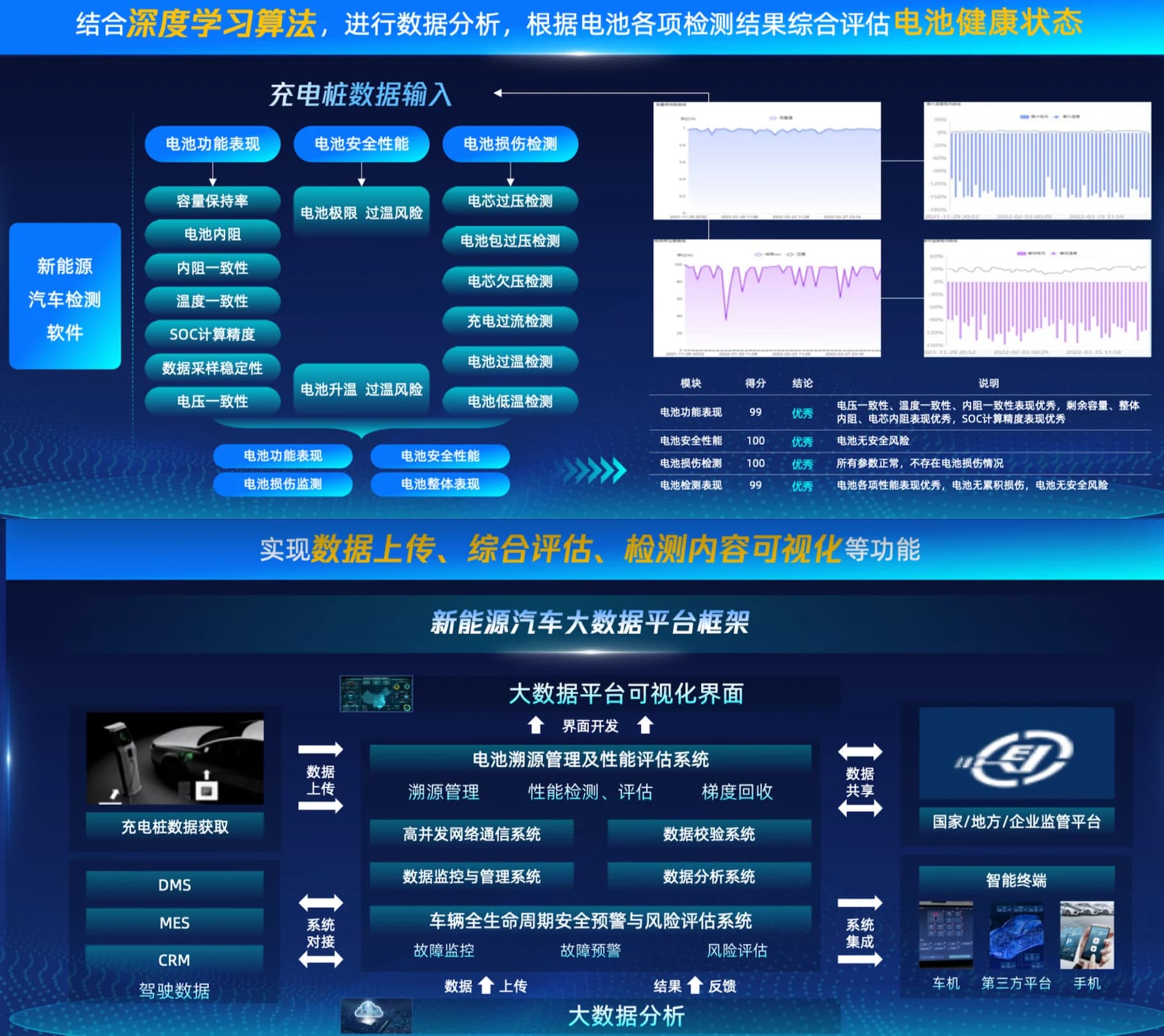
IoT sensors collected charging-equipment data, while edge nodes performed part of the preprocessing and real-time evaluation. The processed data was then sent to the cloud platform for storage, analysis, and model prediction.
06 · System Workflow
The system followed the process below:
Collect charging-pile operating data through IoT sensors
Receive and preprocess the data at edge nodes
Check data integrity and communication status
Store and analyze the data in the cloud
Identify abnormal operating patterns using AI models
Predict potential equipment failures and maintenance requirements
Analyze real-time power demand across charging piles
Dynamically allocate energy according to grid conditions
Notify operators of anomalies and maintenance requirements
Continuously update equipment status and allocation strategies
07 · Technical Implementation
1. AI-Driven Cloud Monitoring
A cloud-based monitoring architecture was designed to integrate real-time analytics with AI-driven predictive maintenance.
The platform was responsible for:
Receiving real-time charging-pile data
Storing equipment status and historical records
Analyzing operating trends
Identifying abnormal conditions
Predicting potential equipment failures
Generating maintenance recommendations
Displaying charging-pile status
Sending fault notifications to operators
Anomaly-detection algorithms identified unusual patterns before they developed into serious equipment failures.
The predictive maintenance mechanism contributed to a 25% reduction in system failure rates.
2. IoT Data Acquisition
IoT sensors were integrated into the charging piles to continuously collect equipment and energy-consumption data.
The collected data represented:
Charging-pile operating status
Power output
Equipment load
Energy demand
Equipment anomalies
Communication status
Historical operating trends
IoT connectivity linked distributed charging devices to a unified monitoring platform, providing the data foundation for real-time analytics and centralized management.
3. Edge Computing
Transmitting all raw data to the cloud can be affected by bandwidth limitations and network latency.
Edge computing nodes were therefore deployed closer to the charging piles to perform local data processing and rapid condition evaluation.
The edge nodes were used to:
Clean and organize real-time sensor data
Filter duplicate or invalid information
Identify anomalies requiring immediate action
Reduce the amount of data transmitted to the cloud
Shorten response time
Maintain selected local functions during unstable network conditions
Processing data closer to its source enabled the system to respond more quickly to demand fluctuations and equipment anomalies.
4. AI Anomaly Detection and Predictive Maintenance
Machine learning models analyzed real-time and historical charging-pile data to identify patterns associated with potential failures.
The system evaluated:
Whether operating parameters deviated from normal ranges
Whether an abnormal condition persisted
Whether multiple indicators changed simultaneously
Whether current data resembled previous fault patterns
Whether equipment performance was declining
Whether preventive maintenance should be scheduled
Predictive maintenance allowed operators to inspect or repair equipment before a failure occurred, reducing downtime and the impact of reactive maintenance.
5. Real-Time Load Balancing
Charging demand varies according to vehicle volume, charging duration, and individual charging-pile utilization.
An adaptive energy-allocation model was developed to distribute available power across multiple charging piles.
The system considered:
Current power demand
Vehicle charging status
Real-time charging-pile load
Available grid capacity
Historical energy consumption
Forecast short-term demand
The dynamic load-balancing algorithm adjusted power allocation as demand changed, reducing local grid strain while maintaining charging services.
6. Energy-Efficiency Optimization
Dynamic allocation was used to improve energy efficiency across the charging network.
The optimization focused on:
Reducing unnecessary power allocation
Avoiding simultaneous overload across multiple charging piles
Adjusting supply strategies according to demand forecasts
Redistributing power as demand changed
Improving overall charging-network efficiency
Maintaining smart-grid stability
This design supported more flexible and sustainable energy management.
7. Support for 5G Smart Grids
The project explored real-time interaction between charging infrastructure and smart grids using the low-latency and high-connectivity capabilities of 5G networks.
Potential functions included:
Large-scale charging-device connectivity
Real-time status transmission
Rapid communication of load changes
Remote fault diagnosis
Dynamic energy dispatch
Coordination between distributed edge nodes
The integration of 5G, IoT, and edge computing improved the grid's ability to respond to changes in EV charging demand.
08 · Challenges and Solutions
HK$1.6 million
09 · My Responsibilities
As a team member, I contributed to:
Analyzing monitoring requirements for EV charging infrastructure
Participating in the overall functional design
Supporting the real-time charging-data workflow
Participating in the IoT data-acquisition design
Supporting AI anomaly-detection and predictive-maintenance research
Supporting coordination between edge and cloud components
Analyzing energy demand and load-balancing logic
Participating in system testing and performance evaluation
Preparing technical documentation and milestone results
Supporting project demonstrations and business-feasibility analysis
10 · Key Contributions and Outcomes
Developed an AI-powered real-time EV charging monitoring system
Integrated IoT sensors for continuous equipment monitoring
Applied edge computing to reduce processing latency
Developed anomaly-detection and predictive-maintenance capabilities
Reduced system failure rates by 25%
Designed a dynamic load-balancing and energy-allocation model
Improved responsiveness to changing energy demand
Supported connectivity within a 5G smart-grid environment
Designed a scalable system architecture
Secured a contract valued at HK$1.6 million
Established partnerships with energy companies for smart-grid deployment
11 · Business and Market Impact
The project evaluated both the technical and commercial feasibility of its real-time monitoring and energy-optimization solution.
A contract valued at HK$1.6 million demonstrated market demand for AI-enabled energy management and predictive maintenance.
The solution has potential B2B applications for:
EV charging operators
Energy-management companies
Commercial parking facilities
Urban charging networks
Industrial parks
Fleet operators
Smart-grid service providers
Its modular architecture allows the system to be adapted according to network scale, energy demand, and deployment environment.
12 · Project Impact
The project integrated AI, IoT, edge computing, and smart-grid technologies into EV charging-infrastructure management.
Its primary value included:
Supporting the transition from reactive to predictive maintenance
Improving charging-pile reliability
Reducing large-scale maintenance pressure
Optimizing real-time power allocation
Reducing excessive local energy loads
Improving smart-grid responsiveness
Supporting sustainable EV infrastructure
13 · Conclusion
This project developed an AI-powered real-time monitoring and energy-management system for EV charging piles.
IoT sensors collected equipment data, edge computing reduced processing latency, and cloud-based AI models supported anomaly detection, failure prediction, and dynamic load balancing.
Through the project, I developed a stronger understanding of EV charging infrastructure, smart grids, IoT data acquisition, edge computing, predictive maintenance, and energy allocation. I also gained experience in cross-functional collaboration, system testing, and commercial-feasibility analysis.
14 · Future Work
Future development could focus on:
Applying reinforcement learning to adaptive energy allocation
Expanding the system to larger charging networks
Integrating renewable energy sources
Improving failure-prediction accuracy
Increasing the explainability of anomaly-detection models
Developing more detailed equipment-health evaluation
Strengthening smart-grid data-transmission security
Improving the independent operation of edge nodes during network outages