Planet Homestead (Shenzhen) Technology Co., Ltd. / AI Agent Platform MVP · AI Product Manager Intern · 2025.03—2025.05 · Published: 2026-06-15
Conversational Freight Ordering Agent
Transforming Natural-Language and Voice Requests into Structured Freight Order Drafts
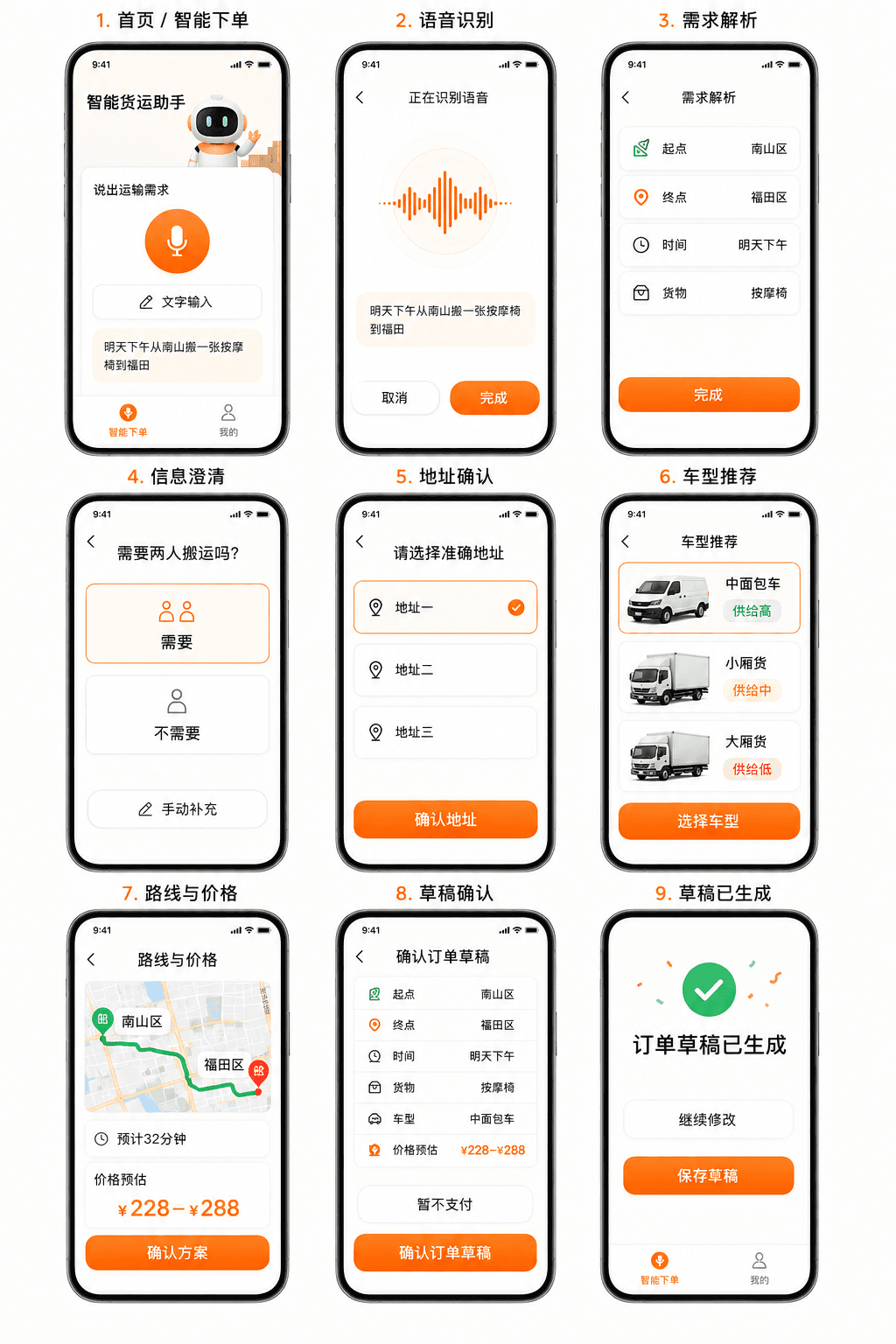
01 · Project Overview
This project was developed during my internship as an AI Product Manager at Planet Homestead (Shenzhen) Technology Co., Ltd.
Using Lalamove’s urban freight-ordering scenario as an MVP case, the project explored how an AI Agent could replace a conventional multi-page order form. Instead of manually entering addresses, cargo details, delivery time, and vehicle type, users could describe their transportation needs through natural language or voice.
The Agent interpreted the request, extracted order parameters, clarified missing information, recommended suitable vehicles, and generated a structured order draft for confirmation.
This was an internal startup MVP designed around a Lalamove freight scenario. I was not employed by Lalamove, and the product was not deployed within Lalamove’s official production environment.
02 · Background
A conventional urban freight order requires users to provide an origin, destination, transportation time, cargo information, handling requirements, and vehicle type across multiple screens.
The process becomes more complicated for household moves, less-than-truckload freight, cross-city transportation, multi-stop delivery, and return trips.
The primary user problems included:
Freight requirements were often expressed in informal and ambiguous language;
Addresses and transportation times required standardization;
Users struggled to distinguish among numerous vehicle types;
Inaccurate cargo descriptions could lead to incorrect recommendations;
Vehicle availability varied by location and time;
Complex orders frequently required additional customer-service confirmation;
Users could accidentally submit incomplete or incorrect information;
Significant user drop-off occurred during vehicle selection and information completion.
The product objective was therefore redefined from helping users complete a form to:
Understanding the user’s request and preparing the order on their behalf.
03 · Product Objective
The project transformed a multi-page order form into a simpler experience built around expression, understanding, and confirmation.
A user could provide a request such as:
“Move a massage chair from Nanshan to Futian tomorrow afternoon, with two people helping.”
The Agent would then:
Identify the freight-ordering intent;
Extract the origin, destination, time, and cargo;
Standardize the address and time information;
Detect missing or ambiguous parameters;
Clarify handling and cargo requirements;
Recommend suitable vehicle types;
Generate a route and price estimate;
Produce a structured order draft;
Allow the user to confirm or modify the result.
The MVP ended at order-draft generation and did not include real payment, driver matching, or dispatch.
04 · Target Users
The primary users were individuals with transportation needs but limited knowledge of freight vehicles and ordering rules, including:
Household-moving customers;
Same-city bulky-item transportation users;
Users with temporary delivery needs;
Small merchants and independent business owners;
Users requiring less-than-truckload, cross-city, or multi-stop transportation.
These users usually knew what they wanted to move and where it needed to go, but they did not necessarily know which vehicle type to select or how to complete standardized freight-order fields.
05 · Core User Flow
The complete interaction flow was:
Voice or text input → Intent recognition → Parameter extraction → Address and time standardization → Clarification → Vehicle recommendation → Route and price proposal → Order draft → User confirmation
Voice or Text Input
Users could describe their request through voice or text. The mobile experience prioritized voice while retaining text input for flexibility.
Intent Recognition
The system determined whether the user wanted to create an order, modify information, ask about a vehicle, or cancel the current action.
Parameter Extraction
The Agent extracted and structured:
Origin;
Destination;
Transportation time;
Cargo type;
Quantity;
Dimensions or weight;
Handling requirements;
Special transportation requirements.
Address and Time Standardization
When an address was incomplete or matched multiple locations, the system displayed up to three candidates for confirmation.
Conversational expressions such as “tomorrow afternoon” were converted into explicit dates and time ranges.
Clarification
When critical fields were missing or ambiguous, the Agent initiated a short clarification flow.
The design principles included:
Prefer binary or limited-choice questions;
Ask only for information required to generate the order;
Complete clarification within two conversational rounds whenever possible;
Allow manual input;
Provide reminders or fallback actions after inactivity.
Vehicle Recommendation
The system generated three vehicle candidates based on cargo type, dimensions, weight, handling requirements, route, and vehicle availability.
Each vehicle card presented:
Vehicle type;
Capacity and cargo-space information;
Recommendation rationale;
Estimated suitability;
Current supply level;
Estimated cost.
Route and Price Proposal
After the user selected a vehicle, the system presented:
Origin and destination;
Estimated distance;
Estimated duration;
Selected vehicle;
Estimated price range;
Potential handling or additional charges.
Order-Draft Confirmation
All information was consolidated into a structured summary. Users could review and edit each field before confirming the draft.
The interface explicitly stated that confirming the draft did not trigger payment.
06 · Core Agent Capabilities
The Agent consisted of five primary capability modules.
Automatic Speech Recognition
Converted user voice input into text and allowed users to verify the result before submission.
Intent Recognition
Distinguished order creation, information modification, vehicle inquiries, and cancellation requests.
Parameter Extraction
Converted unstructured language into structured address, time, cargo, and handling fields.
Clarification and Completion
Detected missing parameters and semantic ambiguity, then generated contextual questions while controlling unnecessary conversational rounds.
Vehicle Recommendation
Combined a vehicle knowledge base, cargo attributes, route information, and supply conditions to generate vehicle candidates and recommendation rationales.
07 · Vehicle Knowledge Base
A retrieval-augmented vehicle knowledge base was designed to manage:
Cargo-compartment dimensions;
Maximum payload;
Recommended cargo types;
Moving and freight scenarios;
Vehicle restrictions;
Relationships between common items and suitable vehicles.
The knowledge base helped the Agent distinguish specific items such as massage chairs, refrigerators, and beds instead of relying only on general model knowledge.
When the available information was insufficient for a reliable recommendation, the Agent asked a targeted clarification question rather than returning an unsupported result.
08 · Interaction Design
The product adopted a voice-first, visually confirmed interaction model.
A purely conversational experience made it difficult for users to inspect the entire order, while a form-only experience recreated the complexity of conventional ordering. The design therefore combined both approaches:
Natural language for expressing complex requirements;
Structured cards for displaying extracted information;
Buttons for answering clarification questions;
Candidate lists for resolving addresses;
Vehicle cards for comparing recommendations;
An order summary for final verification.
This approach preserved the low input cost of a conversational Agent while maintaining user control and transparency.
09 · Measurement Framework
I designed a “1+5” measurement framework to ensure that the team evaluated the complete user task rather than optimizing isolated model metrics.
North-Star Metric
Task Completion Rate (TCR)
TCR measured whether a user successfully progressed from a natural-language request to a confirmed order draft.
Five Module Metrics
ASR accuracy;
Intent-recognition accuracy;
Parameter-extraction accuracy or slot recall;
Clarification-completion rate;
Top-1 vehicle-recommendation hit rate.
Supporting metrics included:
One-shot confirmation rate;
Average clarification rounds;
Average ordering time;
Response latency;
Incorrect-order rate;
Manual-intervention rate;
Funnel drop-off rate.
10 · Testing and Iteration
Approximately 500 real-world request samples were collected, organized, labeled, and tested. The data covered conversational expressions, ambiguous addresses, vehicle selection, complex cargo, and missing parameters.
I worked with operations to define clarification templates and improve the Agent’s questions based on test results.
Key optimization methods included:
Few-shot examples for conversational requests;
A freight-specific slot dictionary;
Prompt and knowledge-base optimization;
Clarification-round limits;
Top-three address candidates;
Timeout reminders;
Log replay for failed interactions;
Idempotent protection for repeated tool calls;
End-to-end testing with realistic user requests.
11 · Results
Internal testing; detailed measurement methodology pending.
During internal MVP testing, the project achieved the following results:
An approximately 80% one-shot confirmation rate;
An approximately 40% reduction in average ordering time;
A nearly 12% improvement in information-completion rate through clarification-copy optimization;
Approximately 500 real-world request samples collected, labeled, and tested;
Address recognition, vehicle recommendation, price estimation, and vehicle reservation abstracted into reusable services;
An approximately 40% reduction in the replication cycle for additional cities;
A reusable conversational service-ordering Agent framework.
These results were obtained from internal startup MVP testing and do not represent official Lalamove production data.
12 · My Responsibilities
As the AI Product Manager, I translated the founder’s initial business concept into a product solution that could be developed and tested.
My responsibilities included:
Analyzing the traditional freight-ordering journey and user drop-off;
Defining product positioning, target users, and MVP boundaries;
Leading requirement clarification, product flows, and PRD development;
Designing a hybrid voice and visual interaction model;
Defining intent recognition, parameter extraction, clarification, and vehicle-recommendation capabilities;
Participating in the vehicle RAG knowledge-base design;
Defining tool invocation and API data contracts;
Establishing the “1+5” measurement and acceptance framework;
Organizing and labeling realistic user requests;
Coordinating algorithm, backend, operations, and testing roles;
Iterating through testing, metric monitoring, and log replay.
13 · Team Collaboration
The project was developed by a four-person team. I acted as the bridge between user requirements and technical implementation.
Algorithm Collaboration
Defined intent categories and parameter-extraction scope;
Organized conversational expressions and exception samples;
Refined prompts, few-shot examples, and the slot dictionary;
Defined clarification triggers and recommendation formats.
Backend Collaboration
Defined the Intent → Entity → Action data structure;
Specified address, vehicle, and pricing tool interfaces;
Designed fallback logic for exceptions, timeouts, and repeated requests;
Aligned logging fields and measurement requirements.
Operations Collaboration
Collected real freight expressions and frequent user questions;
Defined vehicle descriptions and clarification copy;
Validated whether recommendations matched operational experience;
Identified city-level differences in vehicle types and supply.
Testing Collaboration
Translated product metrics into acceptance cases;
Covered standard, ambiguous, and exceptional flows;
Conducted end-to-end testing with realistic requests;
Used log replay to identify failure points.
14 · Platform Strategy
The freight-ordering Agent was intended as the first MVP and lighthouse case for a broader enterprise Agent platform.
The project planned to abstract the following capabilities into reusable modules:
Speech recognition;
Intent recognition;
Parameter extraction;
Information clarification;
Address standardization;
Vehicle or service recommendation;
Price estimation;
API invocation;
User-preference memory;
Task-status notifications.
These modules could later be extended to ride-hailing, local services, enterprise procurement, and other scenarios that require external service execution.
The broader product vision was to replace fragmented searching, comparison, and form completion across multiple applications with a single conversational interface in which the Agent understands the need, selects the service, and prepares the result.
15 · Future Development
Potential next steps included:
Using image recognition to identify cargo type, quantity, and volume;
Improving cold-chain, bulky-item, and special-cargo rules;
Supporting cross-city, multi-stop, and return-trip orders;
Improving the freshness and city adaptability of the vehicle knowledge base;
Connecting real-time vehicle supply and dynamic pricing;
Introducing long-term user preferences and order memory;
Strengthening manual confirmation and audit mechanisms for high-risk orders;
Expanding from a single Agent to multi-agent collaboration;
Supporting private deployment for enterprise customers.
16 · Reflection
This project allowed me to participate in the complete development of an AI Agent product, from business problems and user journeys to capability decomposition and MVP validation.
My primary product insight was:
The value of an Agent is not merely its ability to converse. It must understand a request, complete missing information, invoke services, and deliver a result that the user can verify.
In a transaction-oriented scenario, complete automation should not be the only objective. A more responsible experience allows AI to understand, recommend, and prepare actions while preserving the user’s ability to inspect, modify, and provide final confirmation.