Alibaba Cloud Management Trainee Program · Management Trainee · Solution Architecture & AI Practice · 2026.07-Present · Published: 2026-08-16
From Cloud Foundations to AI Practice: My Alibaba Cloud Management Trainee Journey
A continuous journey of cloud learning, AI experimentation, teamwork, and career exploration
01 · Project Overview
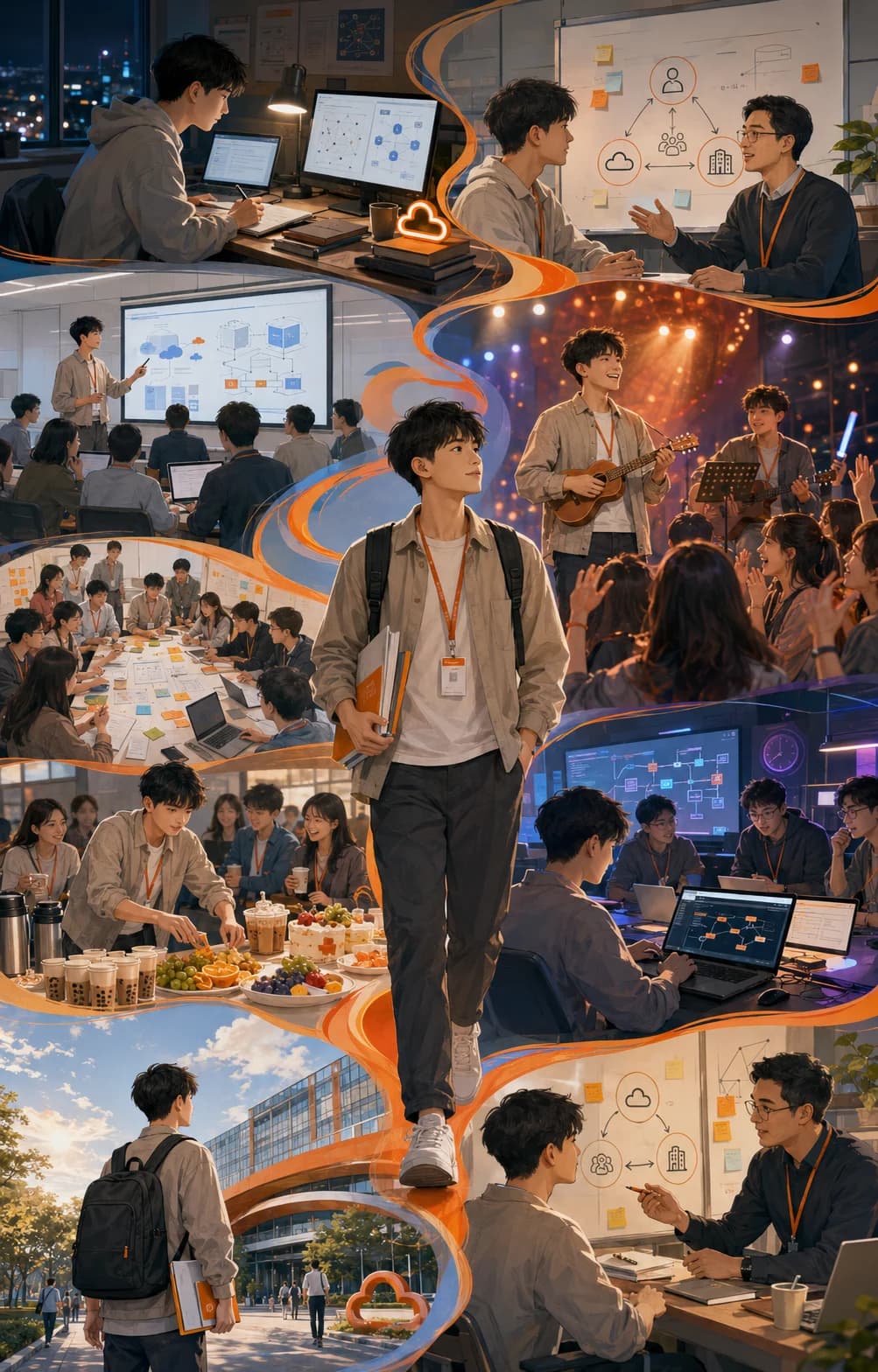
In July 2026, I began my journey in the Alibaba Cloud Management Trainee Program.
This experience is not only about learning cloud products and artificial intelligence technologies. It is also a structured exploration of business understanding, customer value, teamwork, structured thinking, and long-term career development.
Throughout the program, I have participated in cloud computing courses, organizational and role exploration, industry research, cross-functional conversations, team activities, and AI workflow experiments.
As my understanding developed, my focus gradually shifted from learning what a product does to understanding how technology can solve real business problems. I also began exploring the Solution Architect career path as a potential long-term direction.
02 · Phase One: Building a Cloud Computing Framework
The first stage of the program focused on establishing a foundational understanding of the cloud computing industry, Alibaba Cloud's product ecosystem, and customer value.
The learning areas included:
Alibaba and Alibaba Cloud culture
Cloud computing industry trends
Cloud intelligence products and customer value
Computing, storage, networking, databases, cloud-native technologies, cloud security, and big data
Customer experience and the voice of the customer
Infrastructure supply, procurement, and supply chain management
The evolution of cloud computing toward the AI era
Through courses, exhibition visits, and a visit to Cloud Town, I started to understand cloud computing as more than a collection of technical products.
It is an interconnected capability system that brings together infrastructure, enterprise operations, industry scenarios, and customer value.
03 · Moving from Product Features to Value Judgment
During the learning process, I realized that memorizing product functions and technical specifications is not enough to understand a cloud business.
A customer-facing technical professional must also consider:
What problem is the customer actually trying to solve?
What value can the proposed technology create?
What are the strengths, limitations, and suitable scenarios of the product?
How should technical communication change across industries and customer types?
How can technical feasibility be aligned with business objectives?
I therefore began approaching cloud products from the perspective of customer scenarios instead of simply repeating product features.
04 · Structured Thinking and Communication
I participated in a structured-thinking course focused on transforming fragmented information into logical, communicable, and actionable output.
I applied these methods to:
Classroom discussions
Course reviews
Group research materials
Industry information analysis
Project presentations
Personal learning plans
Action tracking and reflection
This experience helped me understand that professional capability is not only about how much someone knows. It is also about identifying priorities and communicating complex ideas clearly.
05 · Industry Research and Team Collaboration
During the cloud foundation stage, I participated in a group research project on automotive cloud market developments.
The project involved information collection, industry analysis, viewpoint synthesis, and presentation preparation. Its most important value was learning how a team could build a shared understanding of a complex topic within a limited period.
My contributions included:
Structuring the research framework
Collecting and organizing information
Supporting market analysis
Participating in group discussions
Integrating different perspectives
Improving the structure of presentation materials
The experience strengthened my communication, information synthesis, and collaborative execution skills.
06 · Exploring Organizations and Career Directions
As the program progressed, I began learning how different organizations, industry teams, and technical roles collaborate in customer projects.
I explored the responsibilities of sales teams, Solution Architects, delivery teams, Product Solution Architects, and research and development teams.
I also developed an initial understanding of technical domains such as computing, storage, networking, databases, cloud-native systems, cloud security, big data, and AI platforms.
Through courses, conversations with experienced colleagues, and project case discussions, I became increasingly interested in the Solution Architect career path.
The role connects customer needs with technical products, industry knowledge, and business objectives. It requires technical depth as well as communication, solution design, collaboration, and project execution capabilities.
07 · Teamwork and Cohort Experience
The program also included collaborative activities outside formal technical courses.
During a band-building activity, I formed a ukulele group with three other trainees. None of us had previous experience, but we needed to complete song selection, role allocation, practice, and a live performance within a limited period.
With guidance from the instructor and close teamwork, we completed approximately four hours of intensive practice and participated in the evening performance.
The experience reinforced several lessons:
Starting quickly is often more valuable than waiting until everything is ready
Clear responsibilities reduce collaboration costs
Time-constrained delivery requires iteration and acceptance of imperfection
Trust and team atmosphere directly affect execution quality
These lessons also became relevant in later research and project assignments.
08 · Phase Two: AI Training and Practice
After completing the cloud foundation stage, I entered the AI training phase.
My learning focus gradually expanded from cloud fundamentals to generative AI, AI product experience, Agents, and workflow design.
At this stage, I became especially interested in how different AI capabilities can be organized into a complete and executable workflow.
09 · AI Workflow Experiment: Life Story Video Generation
During the AI practice stage, I designed a generative video workflow based on a “GTA-Style Real-Life Simulation” concept.
The project explored how a short description, personal experience, or uploaded portrait could be transformed into a game-inspired narrative video.
I divided the generation process into several connected modules:
Understanding the user's story and character information
Generating a narrative structure
Planning the storyboard
Defining characters and scenes
Generating key images
Converting images into video segments
Combining multiple video clips
Adding music and sound effects
Producing the final video
The goal was not simply to generate an image or an isolated video clip. Instead, I wanted to understand how multiple models and tools could be connected through a workflow to complete a more complex content-production task.
Through this experiment, I developed a better understanding of:
Task decomposition for complex AI applications
Prompt design for different workflow stages
Data transfer between Agents and models
Character and visual consistency
Workflow execution efficiency
The relationship between AI capability and product experience
10 · Current Progress
So far, I have completed or participated in the following activities:
Completed the cloud foundation stage
Built an initial understanding of the cloud product ecosystem
Participated in customer value, customer experience, and supply chain courses
Completed structured-thinking training
Participated in an automotive cloud market research project
Joined conversations with experienced colleagues and different role groups
Developed an initial understanding of collaboration among sales, SA, delivery, and R&D teams
Identified Solution Architecture as a key career direction to explore
Entered the AI training stage
Designed and decomposed a generative video workflow
Started building a personal learning and review system
These outcomes remain part of an ongoing learning process, but they have helped me build a development path from technical learning to business understanding and solution design.
11 · My Responsibilities
During this stage, my responsibilities and personal initiatives included:
Completing courses and conducting regular reviews
Participating in industry research and group assignments
Collecting and analyzing industry information
Supporting structured team output
Exploring the responsibilities of different cloud roles
Communicating with experienced colleagues
Designing and decomposing an AI workflow experiment
Establishing personal learning objectives and review logs
Continuously exploring the capabilities required for a Solution Architect
12 · Challenges
Turning Information into a Knowledge System
The program introduces a large amount of product, industry, and organizational information within a relatively short period.
To avoid fragmented learning, I began developing a traceable knowledge framework that connects courses, cloud products, industry cases, and personal reflections.
Connecting Technology with Business Value
Cloud products can be technically complex, while customers are usually more concerned about whether their business problems can be solved.
Learning how to translate technical capabilities into understandable customer value has therefore become one of my main development priorities.
Choosing Between Different Career Paths
The program provides exposure to multiple roles and organizational directions.
I learned that career decisions should not be based only on job titles. They should also consider daily responsibilities, capability requirements, development potential, and personal strengths.
Through continuous conversations and reflection, I gradually identified Solution Architecture as my primary direction for further exploration.
Turning AI Capabilities into Product Experiences
A model's ability to generate content does not automatically make it a complete product.
During the AI workflow experiment, I also needed to consider task structure, input and output design, content consistency, execution efficiency, and user experience.
This encouraged me to evaluate AI applications from a broader product-system perspective.
13 · Next-Stage Plan
My next-stage objectives include:
Continuing professional certification preparation
Completing additional cloud and AI courses
Reading and reviewing AI research papers
Producing AI product experience reports
Preparing for an AI challenge project
Deepening my understanding of Alibaba Cloud Model Studio
Continuing conversations with experienced Solution Architects
Building a more systematic cloud product knowledge framework
Maintaining weekly reviews and action tracking
Improving solution design and technical communication through practice
These items represent future objectives rather than completed outcomes.
14 · Reflection
This journey has helped me understand that professional growth is not simply about accumulating more information. It is about gradually building a personal framework for understanding complex problems.
From cloud foundations to customer value, from industry research to career exploration, and from technical courses to AI workflow experiments, I am learning how to connect technology, business, products, and people.
For me, the value of this journey is not limited to understanding a company or mastering a specific tool. It is about identifying a direction worth pursuing and developing the ability to learn, reflect, and act continuously.
The journey is still in progress.